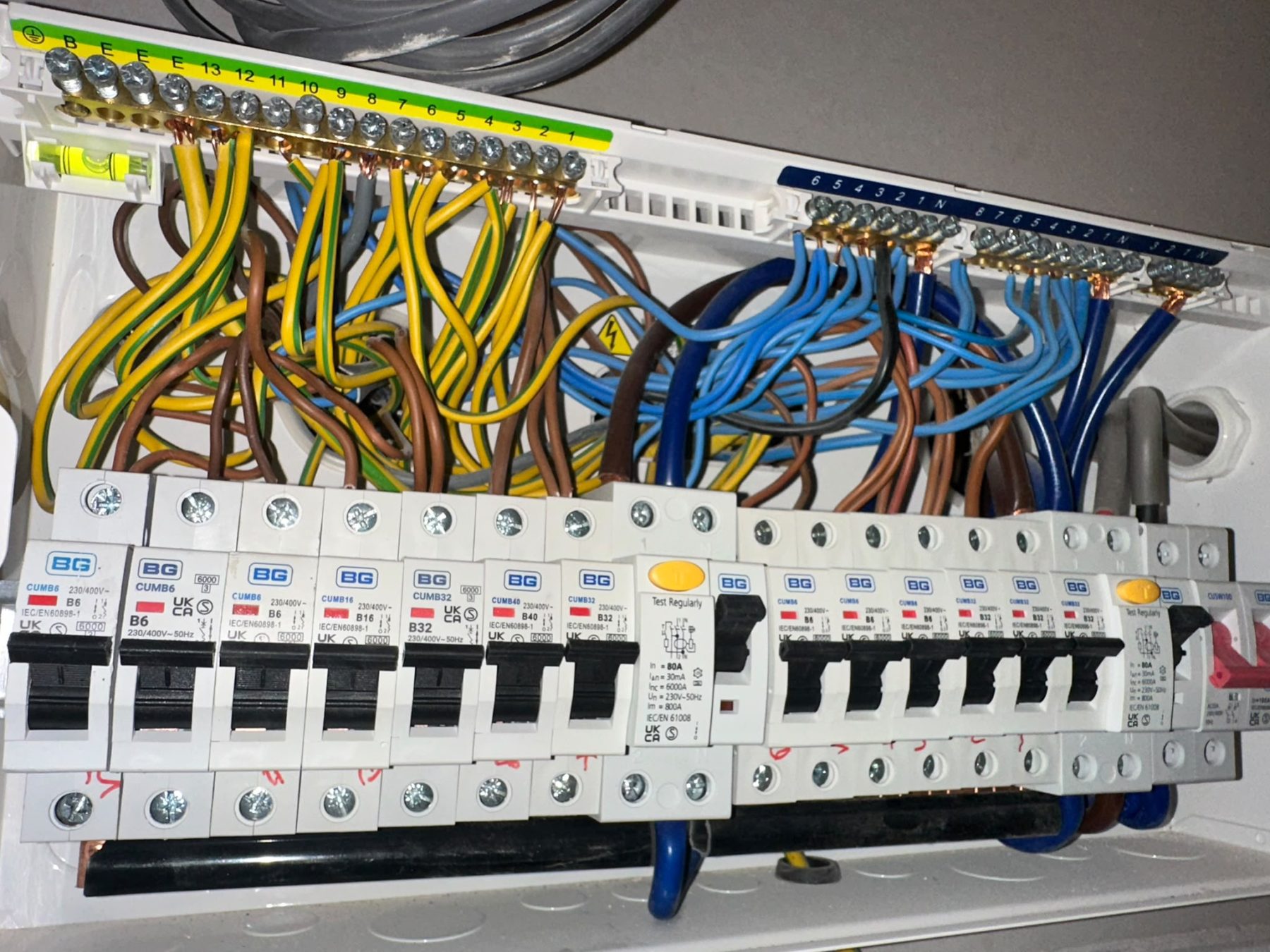
People call it a fuse box. Electricians call it a consumer unit. They are the same thing: the board where the electricity supply to your property is divided into circuits and protected.
It is also the single component where an upgrade makes the biggest difference to the safety of an installation.
What a consumer unit does
The consumer unit takes the incoming supply and splits it into the circuits that serve your property — lighting, sockets, cooker, shower, and so on. Each circuit gets a protective device that disconnects it if something goes wrong.
What has changed over the decades is how much protection that means. An old board with rewirable fuses protects the cable against overload. A modern consumer unit with RCD or RCBO protection also disconnects the supply when current leaks to earth — which is the fault that matters when a person is involved.
Signs your board may need replacing
- Rewirable fuses with fuse wire rather than circuit breakers
- A wooden back box, or a cast-iron or older plastic enclosure
- No RCD protection at all
- Circuits that trip repeatedly with no obvious cause
- Signs of heat damage, discolouration or a burning smell at the board
- No spare ways, when you need to add a circuit
- An inspection report with coded observations relating to the board
An older board is not automatically dangerous, and replacing one that is in sound condition purely because of its age is not always necessary. What matters is its condition, the protection it provides and the installation behind it.
Consumer unit replacement
Replacing a consumer unit is not simply swapping a box. Before the work, the existing circuits need testing — because a new board with sensitive RCD protection will immediately reveal faults that an old board tolerated silently. Finding those first avoids the situation where a new board will not stay on.
The work itself involves isolating the supply, transferring circuits to the new board, testing each one, and labelling the finished installation clearly.
Consumer unit upgrades
Not every improvement needs a full replacement. Adding a way for a new circuit, replacing individual protective devices, or improving specific circuit protection is sometimes all that is required — and if that is the case, we will say so.
Notification and certification
Consumer unit replacement is notifiable work under the Building Regulations in England and Wales, and the installation must be certified. [INSERT INFORMATION] — the company's competent person scheme registration should be confirmed and stated here.
Have your board looked at
If you are not sure what you have, a photograph of the board is often enough for us to tell you whether it is worth discussing further.