Consumer Unit vs Fuse Box: What Is the Difference?
They are the same thing — but the difference between an old board and a modern one is substantial, and worth understanding.
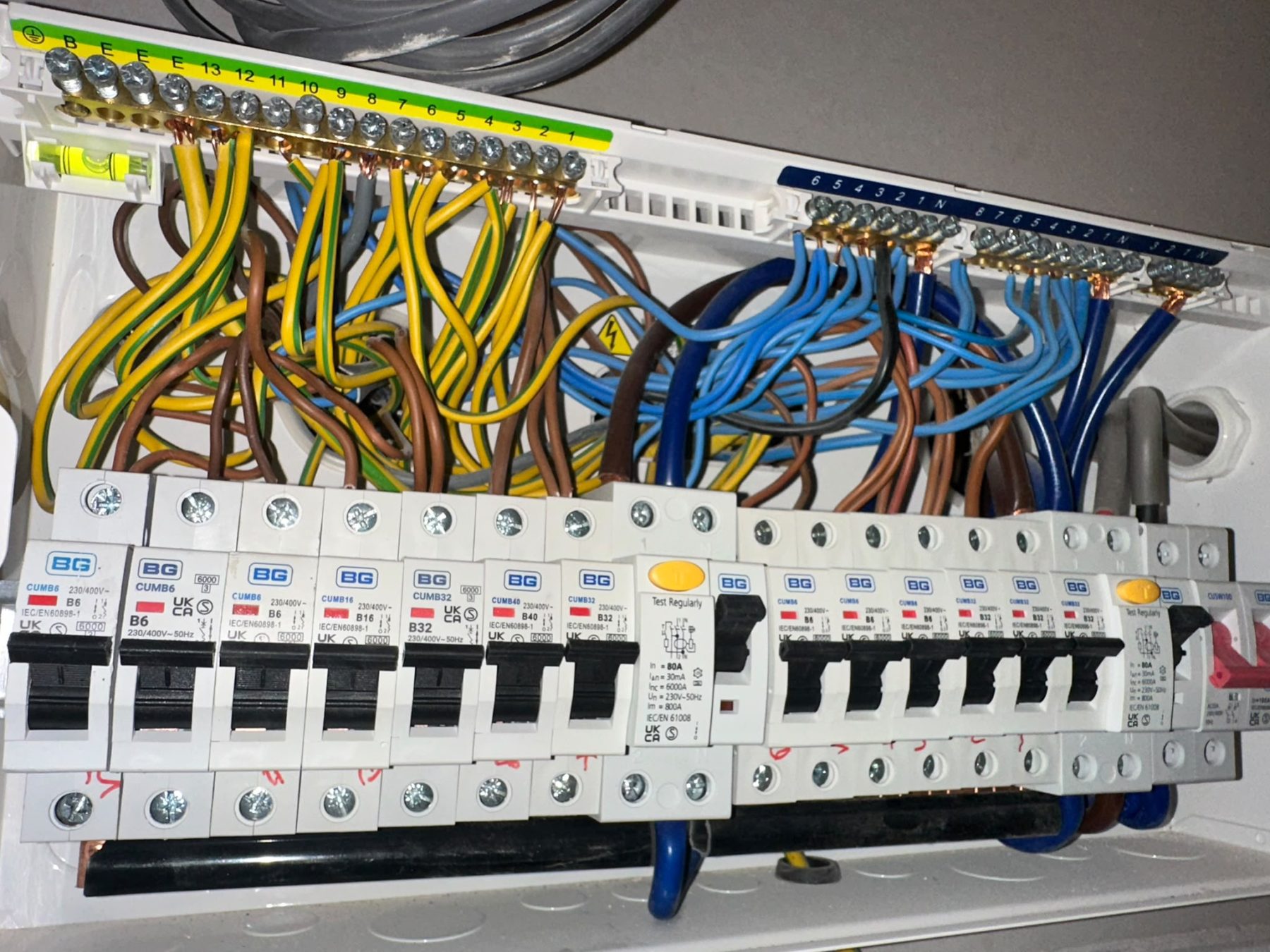
Let us deal with the short version first: a fuse box and a consumer unit are the same thing. "Fuse box" is what most people call it. "Consumer unit" is the term electricians and the regulations use. Both describe the board where your electricity supply arrives and is divided into circuits.
So why does the distinction come up at all? Because in practice people use "fuse box" to mean an old board and "consumer unit" to mean a modern one — and the difference between those two is genuinely significant.
What the board does
Electricity enters your property through a service head and a meter, then reaches the consumer unit. From there it is split into circuits: lighting upstairs, lighting downstairs, sockets, cooker, shower, and so on. Each circuit gets a protective device.
The purpose of that device is to disconnect the circuit when something goes wrong. What has changed over the decades is the range of things it can detect.
Three generations of board
Rewirable fuses
The oldest arrangement still commonly found. Each circuit has a carrier holding a length of fuse wire that melts when too much current flows. It works, but it is slow, it gives no indication of what caused the fault, and the wire can be replaced with the wrong rating — which removes the protection entirely.
Miniature circuit breakers (MCBs)
Switches that trip rather than fuses that melt. They operate faster, they can be reset without tools, and you can see at a glance which circuit has operated. A board with MCBs but no RCD is a genuine improvement on rewirable fuses, but it still only protects against overload and short circuit.
RCD and RCBO protection
This is the meaningful change. An RCD monitors the current flowing out and coming back. If some of it is going somewhere else — to earth, through damaged insulation, or through a person — it disconnects in a fraction of a second.
An RCBO does the same thing but combines it with overload protection in a single device per circuit. The practical advantage is containment: with individual RCBOs, a fault on one circuit disconnects that circuit alone. With a single shared RCD, one fault takes out everything on that side of the board.
What "split load" means
You may hear a board described as split load. It means the circuits are divided into two groups, each behind its own RCD, so a fault does not plunge the whole property into darkness. It was the standard approach for years and remains perfectly serviceable — though boards fully populated with RCBOs handle the problem more neatly.
Why the enclosure changed
Consumer units in domestic premises are now generally expected to have a non-combustible enclosure, which in practice means metal. This followed a pattern of fires that originated inside the board — usually at a poor connection — and were contained badly by a plastic case.
An existing compliant plastic board does not have to be ripped out for that reason alone. But if a board is being replaced anyway, the enclosure is part of what changes.
Which do you have?
Look at the board. Fuse wire in carriers means an old installation. Switches with no test button anywhere means MCBs but no RCD. A test button labelled "test quarterly" means you have RCD protection of some kind.
If you are unsure, send us a photograph. It usually tells us more than a description, and it costs nothing to ask. More detail is on our consumer unit and fuse box page.
Keep reading
Related guides
Signs Your Consumer Unit May Need Replacing
Not every old board needs replacing — but some genuinely do. Here is how to tell the difference without guessing.
Why Testing Before a Consumer Unit Change Matters
The most common way a board replacement goes wrong is skipping the part that happens before the board is touched.
Why Does My Circuit Breaker Keep Tripping?
A breaker that trips is doing its job. Understanding which of three faults it is reporting tells you how seriously to take it.