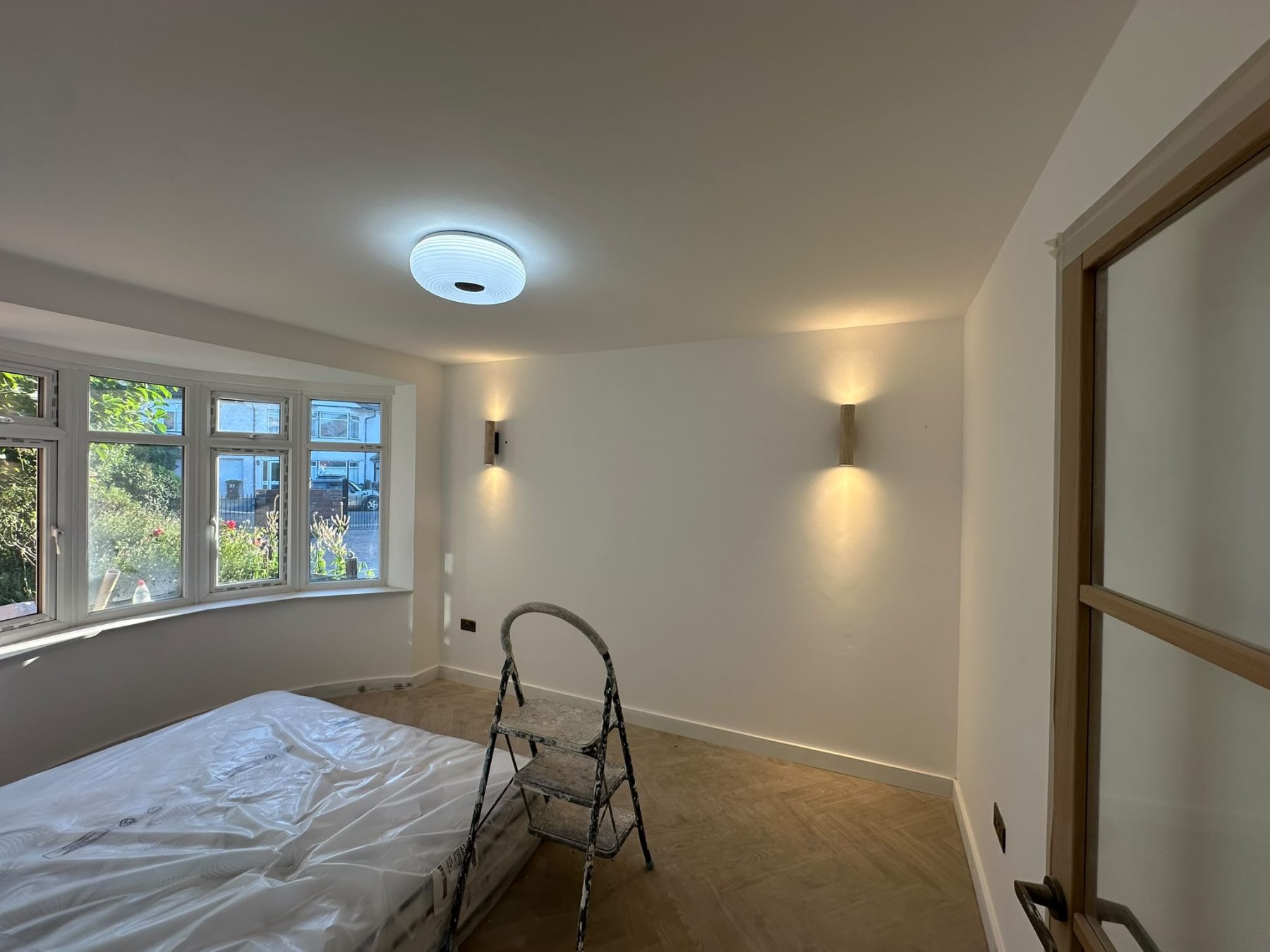
Choosing Lighting for Your Home
Good domestic lighting is layered, consistent and mostly invisible. Here is how to think about it before the fittings are chosen.
BeydilliBright Ltd. — London and the surrounding areas
Service
Indoor, outdoor, commercial, residential and security lighting — designed, installed and upgraded for properties across London.
Lighting is the electrical work people notice. Sockets are invisible until they fail; lighting changes how a room feels every time you walk into it.
It is also one of the few areas where a relatively modest job makes a disproportionate difference — which is why it is worth thinking about properly rather than simply replacing what is already there.
Good domestic lighting is rarely a single bright fitting in the middle of the ceiling. It is usually layered: general light for the room, task light where you actually do things, and accent light for the parts you want to draw attention to.
Colour temperature matters as much as brightness. Warm light suits living spaces and bedrooms; cooler light suits kitchens, bathrooms and workspaces. Mixing the two carelessly within one room is the most common reason a newly lit space feels wrong without anyone being able to say why.
Outdoor lighting has to survive weather, so the rating of the fittings and the way they are installed matter more than indoors. Beyond that it does two jobs at once: making the outside of a property usable and making it safer.
Paths, steps and entrances benefit most. Over-lighting a garden is easy to do and rarely improves it — restraint reads as considered, floodlighting reads as a car park.
Security lighting is a specific case. Motion-triggered lighting at entrances and approaches is genuinely useful; badly aimed floodlights that trigger every time a cat crosses the garden are a nuisance to you and your neighbours, and people stop paying attention to them.
Position, aim, sensitivity and timing all need setting up properly, and security lighting works best alongside CCTV rather than instead of it.
In commercial premises lighting has to meet requirements as well as look right: appropriate light levels for the work being carried out, emergency lighting where it is required, and lighting that suits long operating hours.
Retail lighting in particular is a display tool — how stock is lit affects how it sells.
LED replacement is the most common lighting upgrade, and in premises lit for long hours the reduction in running cost is usually significant. The quality of LED products varies enormously, though, and the cheapest fittings tend to shift colour and fail early.
Where dimming is involved, the driver and the dimmer have to be compatible — mismatched combinations are the usual cause of flicker and buzz after an LED upgrade.
Tell us about the space and what you want from it. We will suggest an approach and quote for the work.
Almost always because the dimmer and the LED driver are not compatible. Older dimmers designed for filament lamps frequently do not work properly with LED loads. The fix is matching the dimmer to the fittings — and it is far easier to get right at specification than after installation.
Related: Lighting Systems
Warmer light (around 2700K) suits living rooms and bedrooms; neutral to cooler light (3000–4000K) suits kitchens, bathrooms and workspaces. The important thing is consistency within a space — mixing colour temperatures in one room is the usual reason a newly lit space feels subtly wrong.
Related: Lighting Systems
In premises lit for long hours, generally yes — the reduction in running cost is real and the payback is often short. The caveat is product quality: cheap LED fittings shift colour and fail early, which erodes the saving and means doing the job twice.
Related: Lighting Systems
Usually fewer than are installed. Rooms lit entirely by a grid of downlights tend to feel flat and clinical. A layered approach — general light, task light where you actually do things, and accent light — produces a better result with fewer fittings.
Related: Lighting Systems
Yes. Outdoor fittings need an appropriate ingress protection rating and correctly installed supplies, because they have to survive weather. Paths, steps and entrances benefit most — over-lighting a garden is easy to do and rarely improves it.
Related: Lighting Systems
Motion-triggered lighting at entrances and approach routes, aimed carefully and with sensitivity set sensibly. Badly aimed floodlights that trigger constantly are a nuisance to you and your neighbours, and people stop paying attention to them — which removes the entire benefit.
Related: Lighting Systems
Yes. It is worth deciding early whether control is per-fitting or per-circuit, because that affects the wiring. Retrofitting smart control after the wiring is finished is possible but usually more limited than designing for it from the start.
Related: Lighting Systems
Yes. Bathrooms are divided into zones based on proximity to water, and fittings need an ingress protection rating appropriate to the zone they sit in. This is not a formality — it is the difference between a fitting that is safe in a wet environment and one that is not.
Related: Lighting Systems
Good domestic lighting is layered, consistent and mostly invisible. Here is how to think about it before the fittings are chosen.
LED upgrades pay back quickly in the right premises — and disappoint in the wrong ones. The difference is mostly product quality.
Most security lighting fails not because it is dim, but because it is aimed badly and triggers constantly.
Call us
Describe the fault or the job and we will tell you what is involved.
Keep exploring