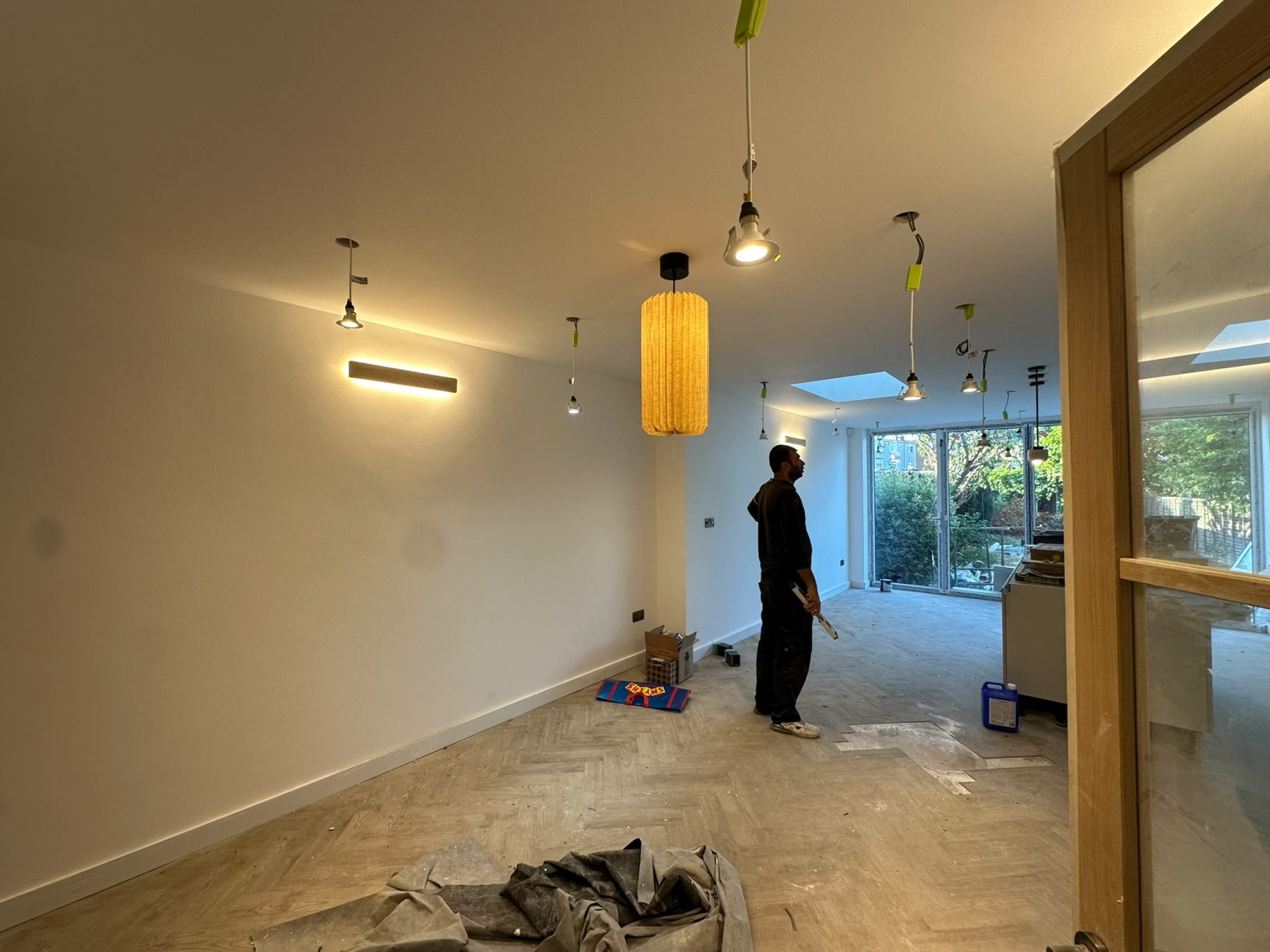
London's housing stock is unusually varied, and that variety shows up in its wiring. A Victorian terrace in Islington, a 1930s semi in Enfield and a new-build apartment in Stratford present three different electrical problems, even when the customer's request is the same.
Domestic electrical work means recognising that and working with what is actually in the building.
Apartment and residential installations
Flats and apartments carry constraints that houses do not: shared supplies, limited routes for new cabling, freeholder or managing-agent permissions, and neighbours on the other side of every wall. Installation work in a flat is usually as much about planning the route as it is about the electrical work itself.
In houses there is more freedom, but also more history — successive owners adding circuits, extensions wired at different times, and sometimes decades of small alterations that were never recorded.
Internal electrical wiring and rewires
A full rewire is disruptive and is rarely the first answer. It becomes the right answer when the existing wiring has reached the end of its serviceable life, when insulation resistance readings show widespread deterioration, or when a renovation is opening up the building anyway.
Partial rewiring — a floor, a kitchen, or a specific set of circuits — is far more common, and often the sensible middle ground.
Domestic electrical repairs
Most domestic calls are repairs: a circuit that keeps tripping, sockets that have stopped working, lights that flicker or fail, or a consumer unit that will not reset. Some of these are minutes of work. Others are the first visible sign of a problem further back in the installation.
We trace the cause rather than treat the symptom, and explain what we have found before going further.
Electrical maintenance for homes
Domestic installations do not need the planned maintenance regime a commercial building does, but they do benefit from being looked at periodically — particularly in older properties, rental properties between tenancies, and any home where the wiring has not been inspected in many years.
Electrical upgrades
Upgrades are usually driven by how the house is used rather than by a fault. More sockets where the family actually sits. A dedicated circuit for a home office or a garden room. An outdoor supply. USB outlets in the right places. Bringing a consumer unit up to a modern standard with RCD protection.
These are the jobs that make a home noticeably better to live in, and they are usually modest work.
Lighting installation
Lighting is where electrical work and design meet. Where the light comes from, how it is controlled and how warm it is make more difference to a room than almost any other single change. We install new lighting, replace ageing fittings, and upgrade to energy-efficient LED lighting — see our lighting page for more detail.
Discuss your home
Tell us what needs doing, what the property is and roughly when you are hoping to have the work carried out. We will explain what is involved and provide a quote.