Domestic Electrical Safety: What to Check at Home
A short, practical list of things worth noticing in your own home — none of which require tools or any risk to you.

Most electrical problems in homes give warning before they become serious. The difficulty is that the warnings are easy to normalise: a socket that has always been a bit warm, a light that has always flickered, a breaker that trips occasionally and resets fine.
Here is what is worth paying attention to. None of it involves opening anything or touching anything you should not.
Look at your consumer unit
Find it — commonly under the stairs, in a hallway cupboard, or in a garage — and look at it properly. You are checking for:
- Whether it has fuse wire or switches.
- Whether there is a test button (that indicates RCD protection).
- Whether the circuits are labelled and the labels make sense.
- Any discolouration, scorch marks or smell of hot plastic.
- Any buzzing or humming.
The board should be silent. If it is not, have it looked at.
Test your RCD
If there is a test button, press it. The RCD should trip immediately. Reset it afterwards. Doing this every few months is sensible — an RCD that does not trip when tested is not protecting anything, and there is no other way to know.
Warn the household first, since it will cut power to several circuits.
Feel your sockets
Not with wet hands, and not by poking at anything. Just notice whether any socket is warm when nothing demanding is plugged into it, or whether there is any browning or discolouration around the pin holes.
Both indicate a poor connection. Poor connections generate heat, and that is how electrical fires start. This is worth acting on rather than watching.
Count your extension leads
Extension leads are designed to be temporary. If one has been in the same place for two years, the room needs another socket.
The particular thing to avoid is daisy-chaining — one extension lead into another — and running high-load appliances such as heaters through them. Also worth knowing: a coiled extension lead running a heavy load can overheat inside the coil even though nothing looks wrong from outside.
Check your smoke alarms
Press the test button on each one. Then look at the date printed on the unit. Most alarms have a stated lifespan of around ten years, and the sensor degrades whether or not the test button still produces a noise.
If your alarms are mains-powered and interlinked, they are part of the fixed installation and should be checked by an electrician when the installation is inspected.
Look outside
Outdoor sockets, lights and any supply to a shed, garage or garden office deserve a look. Check that enclosures are intact, seals are not perished, and nothing is running through a doorway or across a lawn on a domestic extension lead. Outdoor circuits should have RCD protection without exception.
Know when it was last inspected
General guidance in the UK is up to ten years for an owner-occupied home, and up to five years — or at each change of tenancy — for rented property.
If you do not know when yours was last tested, that is itself the answer: it is worth arranging. An inspection establishes the actual condition, rather than leaving you to infer it from whether anything has gone wrong yet.
Things to act on immediately
- Any smell of burning near sockets, switches or the board.
- Any shock, however mild, from an appliance or fitting.
- Scorch marks or melted plastic anywhere.
- A breaker or RCD that will not reset.
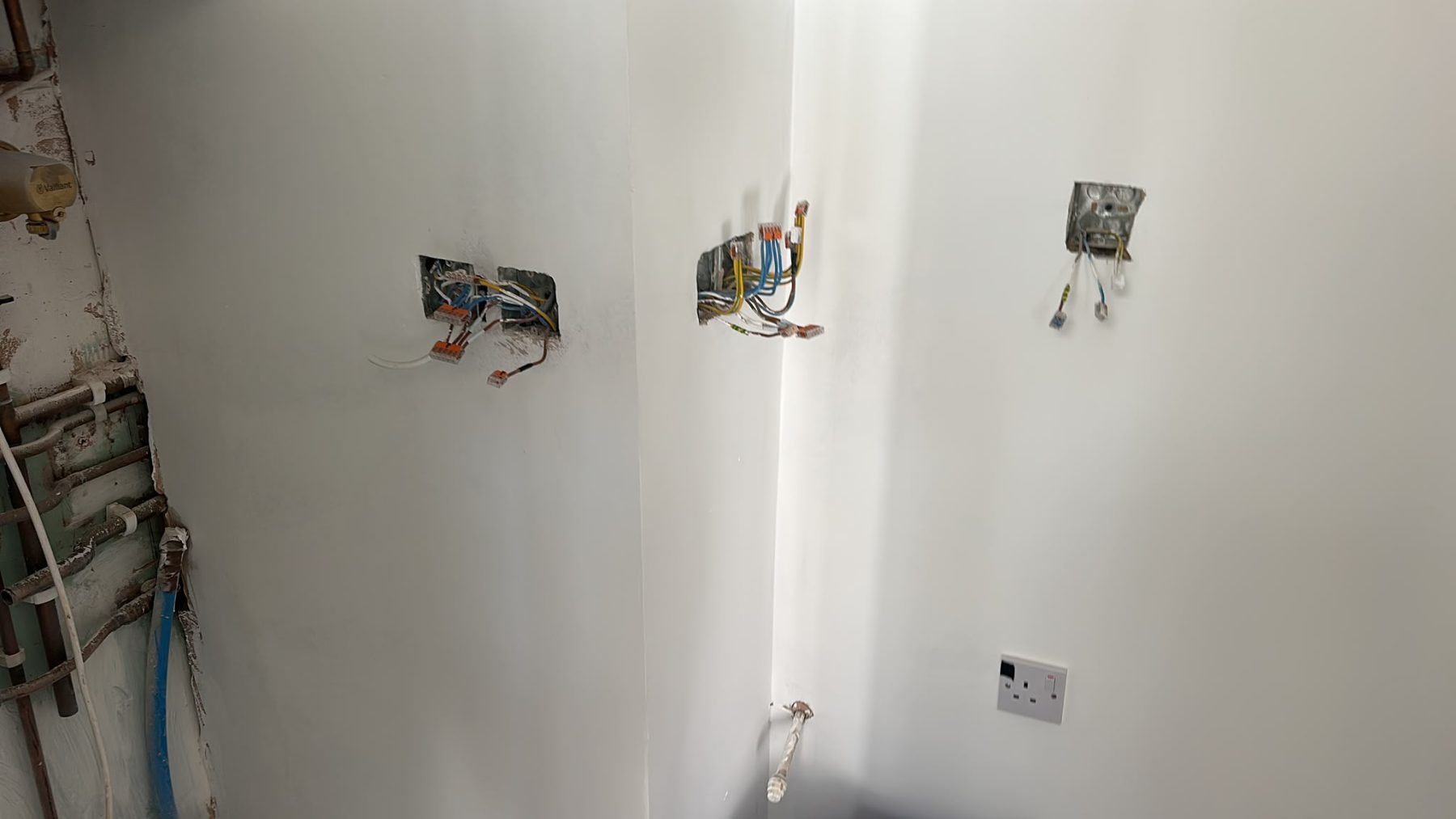
- Exposed conductors anywhere at all.
In each case, stop using the affected circuit and isolate it if you can do so safely. Then call someone. On 07832450917, if you like.
Keep reading
Related guides
What an EICR Is, and What the Codes Actually Mean
Electrical Installation Condition Reports are full of codes that decide whether you have a problem. Here is how to read one.
Common Electrical Problems in London Homes
London’s housing stock produces a recognisable set of electrical problems. Here are the ones we see most often, and why.
When Should You Call an Electrician?
Some electrical problems can wait. Some genuinely cannot. Here is a practical way to tell which is which.